
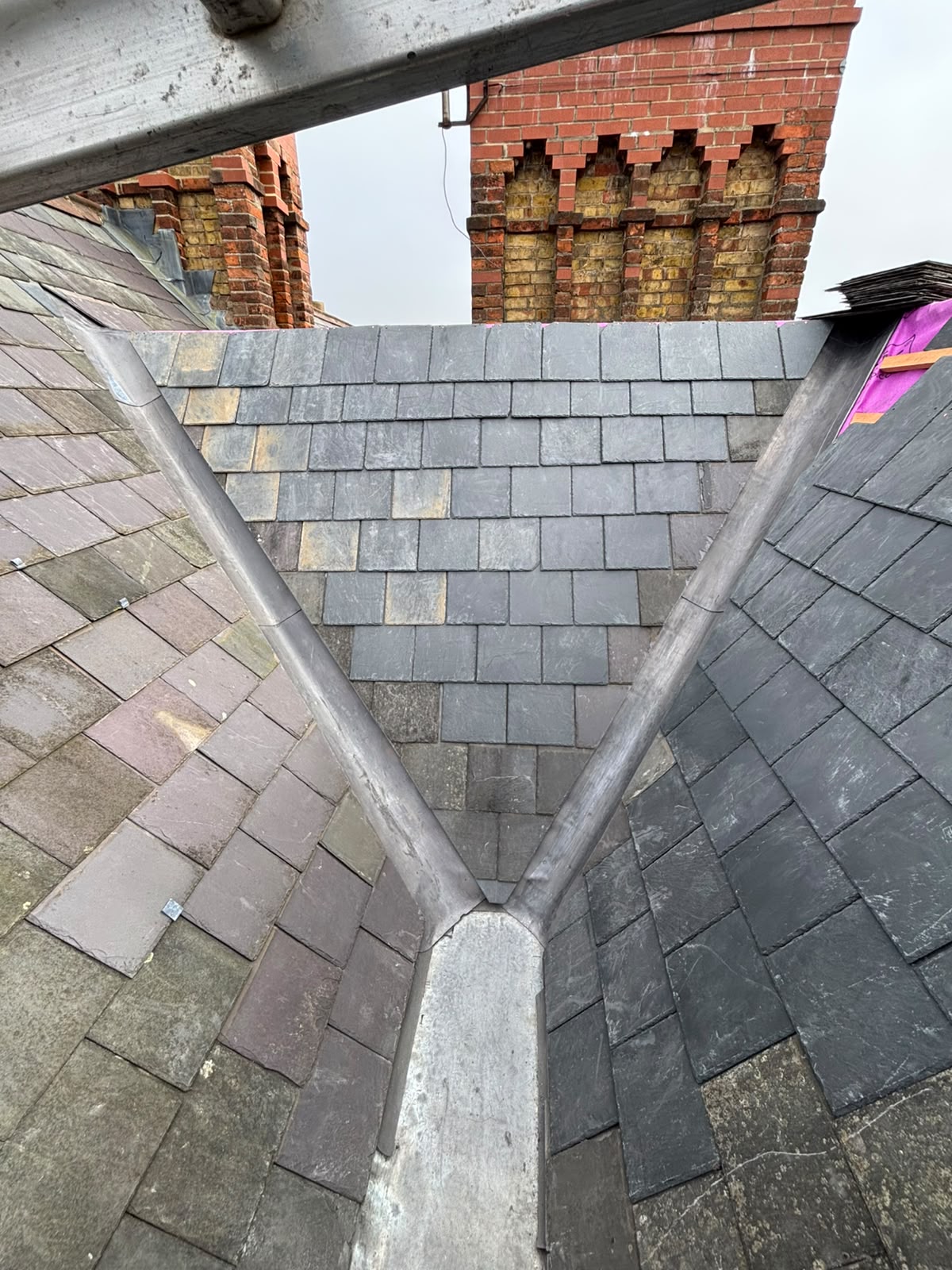
Hand-formed lead valley gutter between slate roof sections by White Horse Roofing, Oxfordshire
Leadwork · Oxfordshire, Berkshire & the Cotswolds

Bespoke Leadwork,
Flashings & Heritage
Detailing in Oxfordshire.

Lead is the material that determines whether a roof stays dry for 5 years or 50. We form, dress and fit code-4 and code-5 lead to LSA standards — for flashings, valleys, chimneys and heritage detailing.

Code-4 & code-5 lead · LSA-standard detailing

Established 2017
1,500+ Jobs Completed
15-Yr Workmanship Guarantee
£1M Public Liability Insurance
Checkatrade 9.78/10
The Service

What leadwork is,
and who it's for.

Lead is the oldest waterproofing material in use in British roofing, and still the best. Properly formed, dressed and fixed, it will comfortably outlast every other component on the roof. Poorly fitted, it splits on the first winter and starts a leak that is traced years later to the wrong-code lead used the wrong way.

White Horse Roofing carries out bespoke leadwork across Oxfordshire, Berkshire and the Cotswolds — flashings, valleys, saddles, aprons, soakers, hips and heritage detailing. All work uses code-4 or code-5 rolled lead, hand-dressed and fixed to Lead Sheet Association (LSA) recommendations.

Who it's for

Homeowners with leaking chimney flashings, failed valleys, or lead detailing that has visibly split or fatigued. Owners of period, listed and Cotswold-stone properties where lead is a heritage requirement. Roofers and builders who need a lead specialist for a specific detail on their project.

When it's needed

As soon as lead visibly splits, tears, lifts away from the surrounding brickwork or tiles, or shows fatigue cracks along a fold line. Lead does not repair itself and does not tolerate patching — once it has failed at a joint, the whole flashing section usually needs replacing.

Why professional

Leadwork is the most specialised trade in roofing. Codes must be right for the situation, sheet sizes limited to LSA maximums to prevent thermal fatigue, joints formed by hand (welts, drips, laps or bossed corners), and the whole detail fixed with lead clips or wedges — never nails through the sheet. Getting any of this wrong causes early failure that is invisible until it leaks.

What Happens If Ignored

The cost of leaving it
until next winter.

Leadwork failure lets water in at exactly the points where it is hardest to detect and hardest to repair — chimney abutments, valleys and roof-to-wall junctions. By the time the leak appears on the ceiling, it has usually rotted roof timbers, saturated insulation and damaged plasterwork. The lead itself is cheap; the collateral damage from a bad detail is not.

Common problems we see

  • Split lead flashings around chimneys and abutments
  • Failed lead valleys with fatigue cracks or unlapped joints
  • Sheets oversized beyond LSA limits and cracked from thermal movement
  • Mastic-and-flashband repairs over lead that has already given up

Mistakes to avoid

  • ×Using code-3 lead where code-4 or code-5 is required — thin lead cracks under thermal movement
  • ×Oversizing lead sheets beyond 1.5 m — thermal expansion causes fatigue cracking within a few years
  • ×Repairing lead with mastic, flashband or silicone — always a false economy; the underlying detail needs replacing
Our Process

Five steps. No day rates.
No surprises.

01

Survey

Detail inspected from scaffold or tower. Cause of failure identified — code, sizing, fixing or detail — and correct replacement specified.

02

Fixed Quote

Written quote covering scaffold, existing lead removal, new lead materials (code specified), forming, dressing and fixing — all fixed price.

03

Strip & Prepare

Existing failed lead removed carefully. Surrounding brick and tile inspected and repaired as needed. Chase cut or reformed for step flashings.

04

Form & Dress

Lead formed to size (within LSA maximums), welts and drips formed by hand, bossed corners where required. Fixed with lead wedges, clips and pointing.

05

Sign-Off & Guarantee

Full walk-round, photographs, site cleared. Written workmanship guarantee appropriate to the scope of the leadwork.

Recent Work

Real jobs, real roofs.

Recent leadwork projects completed by White Horse Roofing Services across Oxfordshire, Berkshire and the Cotswolds.

Bespoke leadwork — after photo 1 by White Horse Roofing Services, Oxfordshire
What You Get

Specific benefits.
No vague claims.

Every point below is something we do on every job — not a marketing line. Ask us at the survey and we'll show you exactly how.

Correct Code Every Time

Code-4 or code-5 specified to the situation — never under-spec.

LSA-Standard Sizes

Sheets sized within Lead Sheet Association maximums so thermal fatigue does not fail the detail.

Hand-Formed Detail

Welts, drips, bossed corners and lapped joints all formed by hand — not cut and mastic'd.

Proper Fixings

Lead clips, wedges and pointing — never nails driven through the sheet.

Heritage-Sympathetic

Correct detailing for listed, period and Cotswold-stone properties.

Written Guarantee

Workmanship warranty in writing on all leadwork installations.

In Detail

The specifics —
materials, methods, situations.

Types of leadwork we install

Step and cover flashings to chimney abutments — with soakers integrated into the tile courses. The standard detail on almost every UK pitched roof, and the single most common source of chimney leaks when done badly.

Lead valleys — open or secret gutter, on Cotswold stone, slate and clay roofs. Formed in code-5 lead with proper laps, drips and clips.

Saddles, aprons and apron flashings — for chimney tops, wall abutments, projecting bays and dormer sides.

Ornamental and heritage lead — traditional detailing for listed and period properties, including hand-bossed corners, decorative ridge lead and lead cladding to bay tops.

The rules that keep lead lasting

Sheet sizes limited to LSA maximums (typically 1.5 m for code-4, up to 1.8 m for code-5) to prevent thermal fatigue splitting. Sheets fixed at the head only, with the rest free to move. Laps and drips formed at every joint so water sheds correctly. Bossed corners where geometry requires it — never cut and mastic'd. Fixed with lead wedges into chase joints, then pointed in appropriate mortar (lime on heritage, cement where appropriate).

Heritage and listed properties

Lead detailing on listed and heritage properties is often prescribed by the conservation officer and the property's listing. We work to the LSA guides, use traditional patina finishes where required, and coordinate with conservation officers to ensure the work is compliant with the listing. Traditional bossed and welted detailing is a core part of what we offer.

FAQ

Everything homeowners
ask us about leadwork.

Something not covered? Call 07522 468971 and we'll answer it directly.

How much does lead flashing replacement cost?+

Simple chimney step and cover flashings typically £450 to £900. Lead valleys £700 to £2,000+ depending on length and complexity. Full heritage lead work quoted individually after survey.

How long does lead flashing last?+

Correctly specified and installed lead flashings routinely last 50+ years. Failure is almost always down to the wrong code, oversized sheets, or bad fixings — not the lead itself.

What is 'code' in lead?+

Lead code refers to sheet thickness — code-3 is 1.32 mm, code-4 is 1.80 mm, code-5 is 2.24 mm, code-6 is 2.65 mm. Roofing flashings normally require code-4 or code-5. Anything less will fatigue and split.

Can lead be repaired or does it need full replacement?+

Small splits at fold lines cannot be reliably repaired — the fatigue that caused the split will continue and re-split any patch. The correct fix is to remove the failed section (typically a full sheet) and replace with correctly-sized new lead.

Do you work on listed and heritage properties?+

Yes — lead detailing on listed and heritage properties is a core part of what we do. We coordinate with conservation officers and work to LSA standards including traditional welted and bossed detailing.

Do you offer emergency leadwork call-outs?+

Yes. For storm damage, active leaks and make-safes across Oxfordshire, Berkshire and the Cotswolds, call us and we will aim to get a surveyor to you the same day. Emergency temporary works can usually be carried out on the first visit so the property is watertight before a permanent repair is scheduled.

Is the quote free?+

Yes for owner-occupied properties. For homes you have not yet bought there is a £100 pre-purchase survey fee — fully deducted from the final quote if you go ahead. Every quote is fixed price, in writing, itemised and never a day rate.

What guarantee do you offer?+

Full re-roofs carry a 15-year workmanship guarantee. Flat roofs carry a 10-year workmanship guarantee. Repairs are covered by a written workmanship warranty appropriate to the scope. All work is backed by £1M public liability cover.

How do payments work?+

A deposit secures your slot in the diary. The balance is paid by bank transfer on completion. On larger projects we offer sensible stage payments so you are never paying ahead of the work delivered.

Which areas do you cover?+

Oxfordshire, Berkshire and the Cotswolds — including Oxford, Abingdon, Didcot, Wantage, Witney, Reading, Newbury, Cirencester and Faringdon. If you are close to the edge of that radius, call us — we can usually help.

Ready to sort it?

Book a same-day survey
and a fixed-price quote.

Family-run, fully insured, and backed in writing. Every quote is fixed price — no day rates, no drift. Call us or send a few details and we'll be in touch today.

15-year workmanship guarantee · Checkatrade 9.78/10 · Same-day surveys